

Masonry Restoration
Paint Removal
In North & South Carolina
A Preservation-First Approach
to Historic Masonry
Damage Free – Eco Friendly
At Merritt Industrial, we have developed a careful, multi-step paint removal process built specifically for brick and masonry across North Carolina, South Carolina, and the greater Southeast.
Our process works great for industrial properties, homeowners looking to get back to a natural brick veneer finish as well as historical preservation/restoration efforts.
Strip the Paint.
Keep the Masonry.
Old brick and stone weren’t built to be painted — but somewhere along the way, a lot of it was. Decades of latex or oil-based coatings now trap moisture, hide deterioration, and obscure the original character of homes, churches, storefronts, and civic buildings across the Carolinas.
Removing that paint is delicate work. Done wrong — with sandblasting, harsh chemicals, or high-pressure water — it can permanently scar brick, erode mortar joints, and destroy the very material you’re trying to save. Seems counterproductive, right?
Merritt Industrial developed a three-step masonry paint removal process specifically to avoid that outcome.
We lift layers of paint from brick, stone, and masonry surfaces while protecting the substrate underneath — an approach suited to residential historic homes, commercial buildings, and institutional and industrial structures throughout North Carolina and South Carolina, with travel service into Virginia, Tennessee, and Georgia for the right projects.
Historic Masonry Anatomy

Why Paint Removal on
Historic Masonry Is Different?
Historic masonry — particularly brick made before the mid-20th century — is often softer and more porous than modern brick, and it was typically laid with lime-based mortar rather than today’s harder Portland cement mixes.
This combination makes it vulnerable to aggressive cleaning methods.
- Sandblasting strips away the brick’s protective fired “skin,” exposing the soft, porous core underneath to accelerated weathering.
- High-pressure water washing forces moisture deep into masonry and mortar joints, which can lead to spalling, cracking, and long-term water damage.
- Harsh chemical stripping without proper control can etch, stain, or discolor the surface it’s meant to clean.
Aggressive cleaning can remove more than dirt or paint.
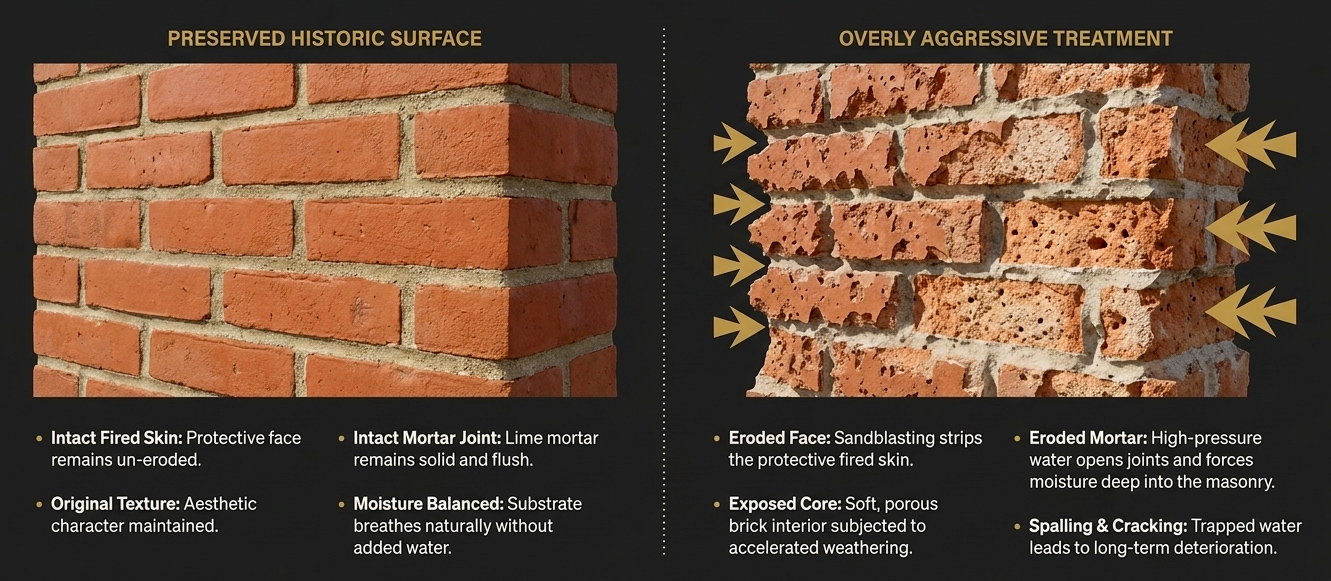
Excessive abrasive treatments cause irreversible physical and aesthetic changes.
For properties in local historic districts or listed on the National Register of Historic Places, preservation guidelines — including the National Park Service’s Preservation Briefs on historic masonry — generally call for the gentlest effective method available, with abrasive methods like sandblasting discouraged or prohibited outright. That’s not just a compliance issue. It’s the difference between a restoration that adds decades of life to a building and one that quietly shortens it.
That’s the gap our process is built to close: strip the paint, keep the masonry.
Our 3-Step
Masonry Paint Removal Process
Step 1: Site Prep & Containment
Every project starts with the work area, not the wall. Our team establishes a full catch basin system to capture removed material before it ever reaches the ground, landscaping, storm drains, or surrounding property — critical when older coatings may contain lead paint. We prep and protect the surrounding surfaces, walkways, windows, and architectural details, then stage equipment and containment for a clean, controlled worksite. This step is handled by an experienced, dedicated crew who have done this on real historic properties, not a generic cleaning outfit learning on the job.
Step 2: Proprietary Bond-Release Solution
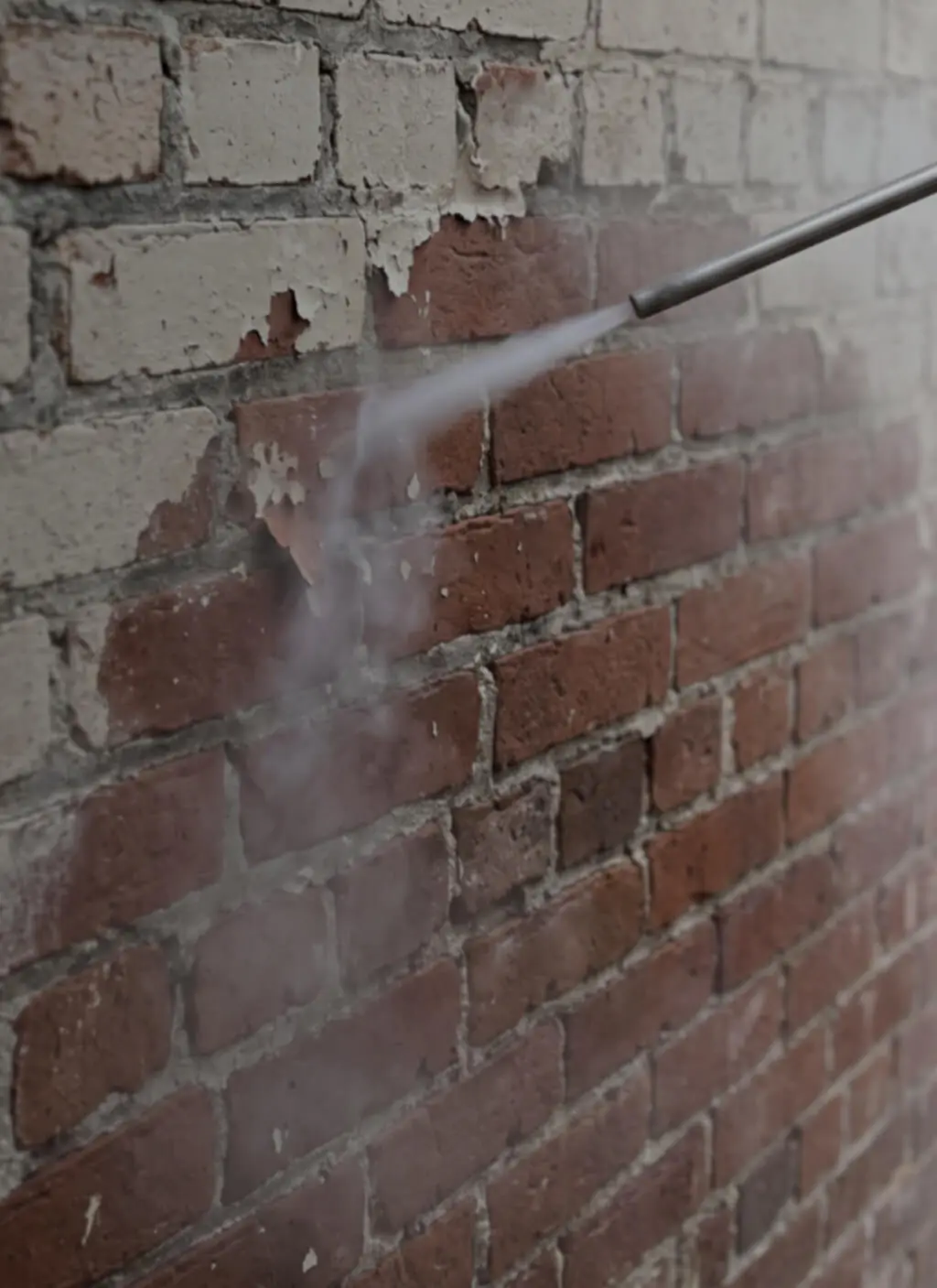
We apply a proprietary solution formulated to break the bond between the paint film and the masonry surface beneath it — without saturating or attacking the substrate the way generic strippers can. The solution is allowed to “flash,” penetrating and loosening the paint layer from the surface. Once it has done its work, our crew scrapes and peels back the loosened paint by hand, layer by layer, allowing material to dry before removal. Every bit of spent material is contained, collected, and hauled off site for proper disposal in accordance with applicable regulations — nothing is left behind, buried in the yard, or washed into the storm system.
Step 3: Dry Ice Blasting for Residue in Porous Areas
Even after chemical bond release and hand-scraping, historic brick and masonry are porous — paint pigment and residue can sit deep in the pores, mortar joints, and surface texture where a scraper can’t reach. This is where dry ice blasting finishes the job. We blast the surface with dry ice (solid CO₂) pellets accelerated through compressed air. On impact, each pellet does two things at once: it delivers a burst of thermal shock that makes remaining paint residue brittle and easy to release, and it instantly sublimates — turning directly from solid to gas — which lifts the loosened residue away from the surface.
Why this step works so well on masonry specifically: dry ice blasting is non-abrasive.
Unlike sandblasting or wire brushing, it doesn’t rely on grinding away material to clean the surface, so it doesn’t erode the fired face of the brick or open up the mortar joints.
And because the CO₂ pellets sublimate on contact, the process leaves zero secondary media behind — no sand, no grit, no slurry to clean up or dispose of separately, and critically, no added water to soak into masonry that’s already vulnerable to moisture damage.
For a material as porous and unforgiving as historic brick, that combination of “aggressive on the paint, gentle on the substrate” is exactly what preservation-grade paint removal calls for.
Planning a masonry paint removal project?
Talk with Merritt Industrial about the right approach for your building. Call us today!
Contact us today for a free evaluation
Let Merritt find the right solution for your projects with a free onsite estimate.
Our trained technicians are ready for the job. Call today to speak to a qualified professional who understands your needs and our technology.
Built for Preservation, Not Just Cleaning
We know that historic masonry paint removal isn’t a typical pressure-washing job, and we treat it that way:
- No sandblasting. We never use abrasive media that erodes original brick or stone.
- No high-pressure water. We don’t force moisture into mortar joints and masonry that’s already decades — or centuries — old.
- Full material containment. Every layer of removed paint is collected and disposed of properly, not left on site.
- Trained, dedicated crews. The same team handles your project start to finish — not a rotating rental crew.
- Lead-paint-aware process. Given the age of most historic structures, our containment and disposal practices account for the likelihood of lead-based coatings.
Who We Help

Commercial and industrial property owners with painted brick or block structures who want the masonry look restored without damaging the building envelope

Homeowners restoring painted brick exteriors, chimneys, foundations, and garden walls back to their original masonry character

Historic district property owners working within local design review or Certificate of Appropriateness requirements

Churches, courthouses, and civic buildings with painted masonry facades in need of restoration or resurfacing

Contractors and preservation architects who need a subcontractor experienced in non-destructive masonry paint removal for a rehabilitation project, including projects pursuing historic tax credits
Frequently Asked Questions
About Masonry Paint Removal
Our process is built around the opposite goal. Rather than grinding or blasting away material with abrasive media, we use a bond-release solution followed by hand removal, then dry ice blasting for residual paint in porous areas — a method that doesn’t erode the fired face of the brick or force moisture into mortar joints the way sandblasting or pressure washing can.
Yes. Our process is designed for exactly this — multiple historic paint layers are removed in stages during Step 2, with dry ice blasting in Step 3 addressing what’s left behind in porous or textured areas.
Dry ice blasting is non-abrasive — the CO₂ pellets sublimate on contact rather than grinding the surface — which is why it’s widely used in historic restoration on delicate materials, including soft brick, limestone, sandstone, and even fragile architectural detail.
Older painted structures may contain lead-based paint. We contain, collect, and remove all material from the job site for proper disposal rather than allowing debris to enter the ground, storm drains, or surrounding landscaping.
Yes, we work with homeowners, contractors, and preservation professionals navigating local historic district guidelines and Certificate of Appropriateness requirements. We recommend confirming your project’s approved treatment methods with your local historic preservation commission before work begins; our process is designed to align with preservation best practices that discourage abrasive methods like sandblasting.
North and South Carolina are our core service area, but we travel to Virginia, Tennessee, and Georgia for the right historic preservation projects. Contact us with your project details and location.
Timeline depends on the size of the structure, the number of paint layers, and site access. After an on-site or photo-based assessment, we’ll provide a realistic project timeline along with your estimate.